Search every volume:
Volumes
-
 Vol 1 Overview & Decision Tree What a scope clock is, the six ways to get one, and which path fits
 -
 Vol 2 How a CRT Vector Display Works The electron gun, electrostatic deflection, phosphor persistence, and why a clock is drawn as strokes
 -
 Vol 3 The High-Voltage Power Supply The rails an electrostatic CRT needs, the two ways to make them, and how to tame the ripple without dying
 -
 Vol 4 Deflection & Video (Z) Amplifiers Turning a 3.3 V DAC output into push-pull plate drive and a fast cathode blanking signal
 -
 Vol 5 Timebase & Vector-Drawing Firmware The MCU, the DACs, and how the face is actually drawn — keeping time, steering the beam, and beating flicker
 -
 Vol 6 CRT Selection & Sourcing Reading a tube's spec, the TubeTime compatibility list, the DG7-32 and 6Lo1i pinouts, and where the glass actually comes from
 -
 Vol 7 Build A — Dutchtronix AVR Scope Clock (owned) The classic ATmega scope clock: board, document set, firmware, and living with it
 - Vol 8 Build B — OSC4.4 (owned) The owned OSC4.4 scope clock, built stage by stage: HV supply, low-voltage and wave-shaper, deflection and logic, CRT wiring, bring-up, and the Wi-Fi/GPS modules
-
 Vol 9 Buy a Kit or Finished Unit The low-effort end of the decision tree — Oscilloclock, AliExpress controller boards, the Altoids build, and the kit landscape
 -
 Vol 10 Build From Scratch (open-source crt-driver) The TubeTime board set, supplying your own vector source, and rolling your own design
 -
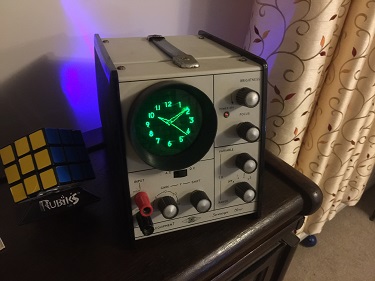 Vol 11 Enclosure, Finishing & the Steampunk Treatment Mounting the tube, taming the high voltage inside the box, and dressing it in brass
 -
 Vol 12 Safety, Calibration, Troubleshooting & Cheatsheet The mandatory high-voltage safety brief, the bring-up and adjustment procedure, a fault-finding guide, and a laminate-ready reference card