Search every volume:
Volumes
-
 Vol 1 Overview & Decision Tree What a discrete-logic LED clock is, how it builds digital logic from bare transistors, and which path fits your bench
 -
 Vol 2 The LED Display Seven-segment red LEDs, the colon dots, and why every lit segment burns continuously — static drive, one current-limiting resistor at a time
 -
 Vol 3 Transistor-Level Building Blocks The handful of circuits the whole clock is made from — the transistor as a switch, diode gates, the bistable latch, the toggle flip-flop, and the comparator
 -
 Vol 4 Counters & Frequency Division From a falling-edge toggle flip-flop to the divide chain that turns 60 Hz mains into seconds, minutes, and hours
 -
 Vol 5 Decoders & Seven-Segment Drive How two ranks of diode logic turn a counter's four-bit binary count into a lit numeral, statically driven, one segment at a time
 -
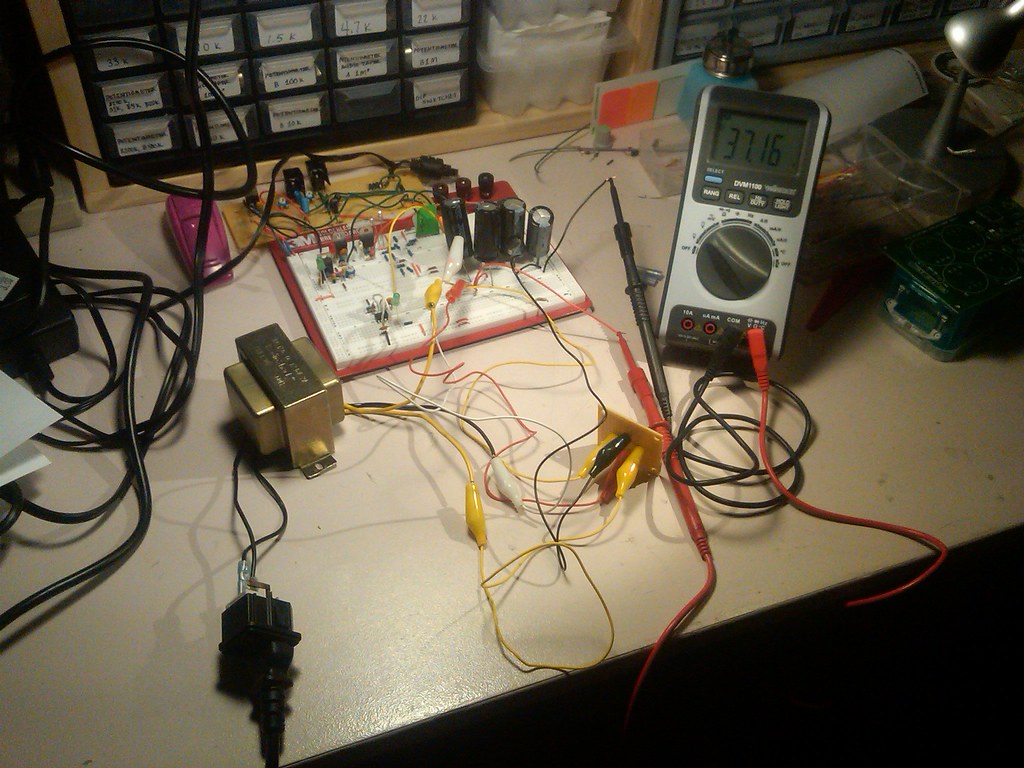 Vol 6 The Timebase — Mains 60 Hz How a clock with no crystal keeps excellent time by counting the power line, the low-voltage supply that powers the board, and the clever pulser-and-comparator circuit that extracts a clean 60 Hz and rejects line noise
 -
 Vol 7 Build It Yourself A practical bench walkthrough of the KABtronics Transistor Wall Clock kit — the parts, soldering 2,700 joints, the section-at-a-time build order, and the power-up test for each section
 -
 Vol 8 Buy a Kit or Finished Clock The KABtronics kit as the realistic buy, why finished discrete-logic clocks are rare and pricey, the visible-logic genre and its cousins, and a skill/time/cost trade-off you can act on
 -
 Vol 9 The Collected Project & Troubleshooting A decision-by-decision walk-through of the KABtronics design, its longevity, and the use-your-brain method that gets a 2,700-joint board working
 -
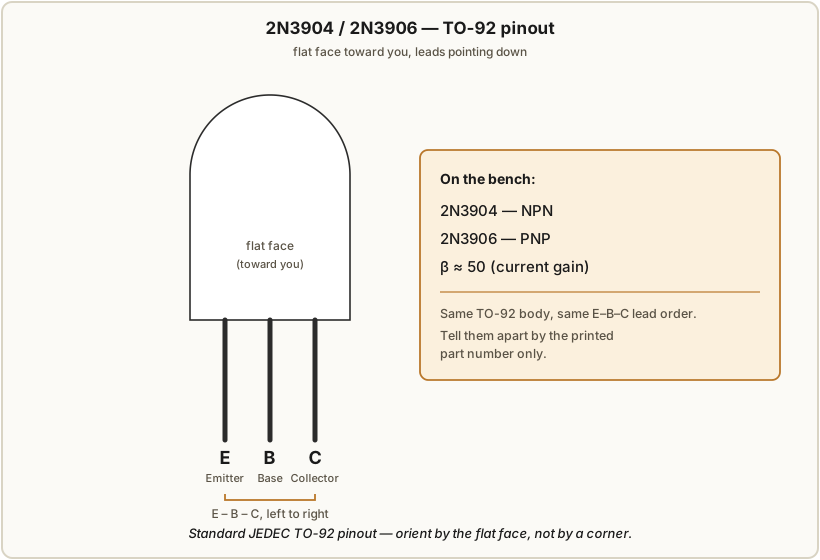 Vol 10 Cheatsheet & Glossary The discrete-logic LED clock on one laminated card — signal chain, count tables, building-block and kit reference, plus an A–Z of every term in the series